
If a pipe or hose bursts, turn the water off at the nearest isolation valve or the main stop tap near the water meter. Keep away from power points and appliances the water has reached. Then call a licensed plumber. If anyone is in danger, call triple zero (000).
Most plumbing problems give you some warning first. A rusty hose under the sink, a toilet that runs in the night, pipes that bang. These are the checks we would do at our place. All of them are safe for anyone, and none of them need a spanner.
For each one: what to look for, what can happen if it is left, what you can safely do yourself, and who to call. In Queensland most plumbing work has to be done by a licensed plumber, so the last one is often the easy part.
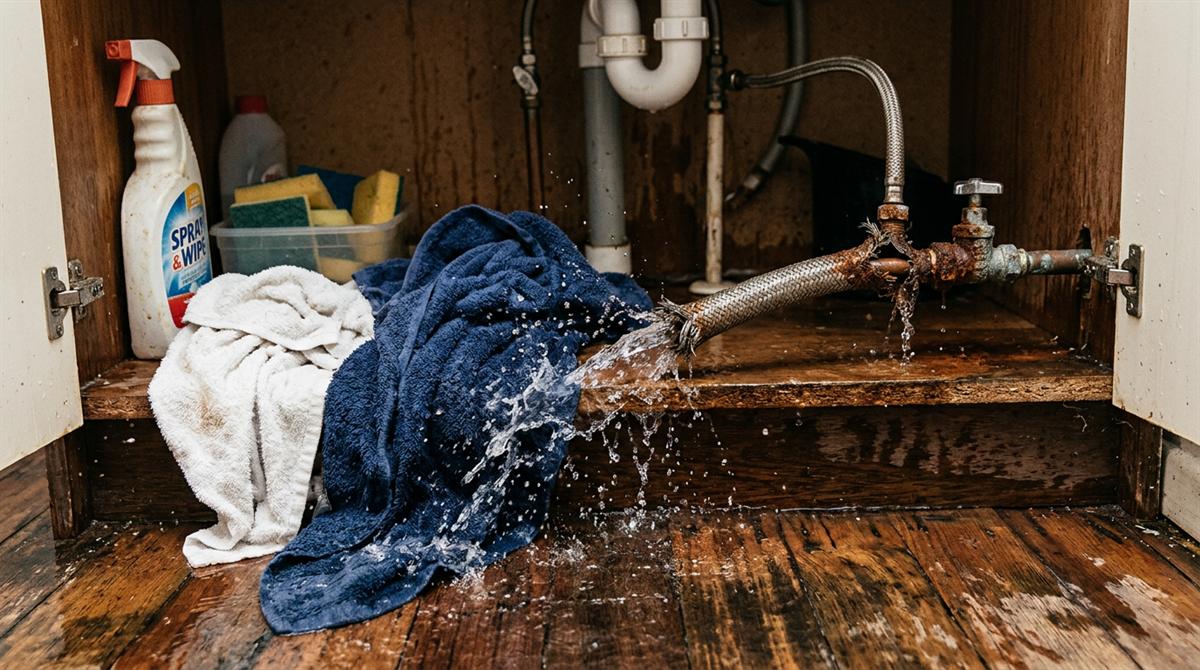
Braided flexi hoses
- What to look for
- Open the cupboards under the kitchen sink, the vanities and the laundry tub, and look behind the toilet. If you can see the dishwasher hose without moving anything, check that too. Look along each braided hose for rust spots or brown staining on the braid, frayed or broken wires, kinks or tight bends, and any bulge or bubble. Check the cupboard floor for water marks, swelling or a musty smell.
- What can happen
- A worn hose can split or burst with no warning. It is connected to the mains, so water keeps pouring out until someone turns it off. If that happens while you are out or asleep, it can flood a fair bit of the house.
- What you can safely do
- Find out where the water turns off now, before you need it. Most hoses connect to a small tap on the pipe, called an isolation valve, and the whole house turns off at the main stop tap near the water meter. Check you can reach them and know which way they turn. If a valve is stiff, do not force it, because old valves can break. Mention it to a plumber instead. Many hose makers state a service life or recommend regular checks, so look at the packaging or the maker's advice rather than guessing how old is too old.
- Who to call
- A licensed plumber to replace worn hoses, and any valve that will not turn. Replacing a hose is not on the QBCC's short list of plumbing work you can do without a licence.
A leaking toilet
- What to look for
- Two simple tests. The dye test: put a few drops of food colouring in the cistern, the tank at the back, just enough to colour the water. Do not flush. Wait about 15 to 30 minutes, then look in the bowl. The listening test: when nobody has used the toilet for a while, listen for the cistern refilling by itself, or a constant trickle or hiss. You might also see a thin stream of water running down the inside of the bowl.
- What can happen
- Colour in the bowl means water is leaking from the cistern into the bowl. A leaking cistern runs day and night, and it shows up on the water bill. It is easy to miss, because the water goes straight down the toilet.
- What you can safely do
- Flush once you are done, to clear the colour. While you are there, check the floor around the base and the hose behind the toilet. A few simple cistern repairs are on the QBCC's list of work you can do without a licence, so check the list before you start. Anything beyond that is a job for a licensed plumber.
- Who to call
- A licensed plumber.
-
StartDo the dye test.A few drops of food colouring in the cistern. Do not flush. Wait about 15 to 30 minutes.
-
QuestionIs there colour in the bowl?If no, go on to step 3.If yesThe cistern is leaking into the bowl.Flush to clear the colour, and call a licensed plumber.
-
QuestionDoes the cistern refill by itself, or trickle or hiss when nobody has used it?If no, go on to step 4.If yesWater is still getting through.That is a leak too. Call a licensed plumber.
-
QuestionIs there water on the floor around the toilet, or a rusty or damp hose behind it?If no, go on to step 5.If yesTurn off the small tap on the toilet's water pipe, if it turns easily.Do not force a stiff tap. Then call a licensed plumber.
-
FinishThe toilet is probably not your leak.If the water meter still moves with everything turned off, the leak is somewhere else. Call a licensed plumber.
Water pressure, too low or too high
- What to look for
- Too low: weak showers, taps that are slow to fill a kettle or a bucket, or pressure that drops away when another tap is running. Too high: pipes that bang or shudder when a tap is turned off quickly, a hot water relief valve that drips a lot, or hoses and fittings that leak or burst more often than they should.
- What can happen
- Low pressure is mostly a nuisance. High pressure is harder on pipes, fittings and appliances, and it is worth sorting. The plumbing standard sets a maximum of 500 kPa at outlets inside a home, and many newer homes have a pressure limiting valve, usually at or near the water meter, to keep it under that.
- What you can safely do
- Work out whether it is one tap or the whole house. That tells your water supplier or the plumber where to start. If it is the whole house, check the main stop tap at the meter is fully open, and ask the neighbours if theirs is low too. Unitywater suggests a simple bucket test: turn the tap nearest the water meter, usually the front garden tap, on full and time how long it takes to fill a 9 litre bucket. If it takes a lot longer than 30 seconds, you may have low pressure. Leave the pressure limiting valve alone. Adjusting it is a plumber's job.
- Who to call
- If it seems too low, your water supplier or a plumber can test it. Your supplier is on your water bill: Urban Utilities in Brisbane, Ipswich, Lockyer Valley, Scenic Rim and Somerset, Unitywater in Moreton Bay, the Sunshine Coast and Noosa, and in the other areas we cover, the local council. If it seems too high, or the pipes bang, a licensed plumber can test it with a gauge and check or fit a pressure limiting valve.
The hot water relief valve
- What to look for
- Most storage hot water systems have a temperature and pressure relief valve, usually called the TPR valve or just the relief valve. It sits near the top of the tank, with a small lever on it and a drain pipe running from it. Its job is to let water out if the temperature or pressure inside the tank gets too high. Look at where the drain pipe ends and see what is coming out.
- What can happen
- A small drip from the drain pipe while the water is heating can be normal, because water expands as it heats. A steady stream, or water running when the system is not heating, means something is not right. It could be the valve, the water pressure or the system itself.
- What you can safely do
- Many manufacturers recommend easing the lever every so often to keep the valve working. Your system's manual says how often and how to do it. The QBCC says home owners and tenants can operate the valve themselves, but care must be taken to avoid scalding and to make sure the valve closes properly afterwards. The water that comes out is very hot, so stand clear of the drain outlet and keep kids and pets away. Never block, cap or tie off the valve or its drain pipe, even if it drips. The QBCC also says it is generally recommended to have a hot water system serviced every five years by a licensed person, following the maker's advice.
- Who to call
- A licensed plumber if the valve runs in a steady stream, will not close properly after you ease it, or the system has not been serviced in years. Gas systems may also need a licensed gasfitter, and electrical faults a licensed electrician.
Slow drains and sewer smells
- What to look for
- A sink, shower or bath that drains slowly, gurgling from a plughole or the toilet, water coming back up through a shower or floor waste, or a sewer smell inside or outside. Check whether it is one fixture or several. If more than one is slow, or the toilet gurgles when the shower drains, the problem is probably further down the line. Outside, find the overflow relief gully, the grated outlet in the ground near the house. If it is overflowing, the sewer line is blocked.
- What can happen
- Blockages from fat, wipes, hair and tree roots tend to get worse, not better. Left long enough, a blocked sewer line can overflow at the gully outside, or back up into the lowest shower or toilet in the house.
- What you can safely do
- For a slow sink or shower, clear the hair and gunk you can reach at the plug and the grate, then run hot water from the tap. A plunger can help with a simple sink blockage. Do not mix drain cleaners, or pour one product in after another. Follow the label, and if it has not worked, stop there. For a sewer smell from a shower or floor drain nobody uses, run water into it for a minute to refill the water seal that keeps the smell out. Keep the grate on the overflow relief gully clean and clear so it can do its job.
- Who to call
- A licensed plumber or drainer for anything past the plughole: a blockage that keeps coming back, more than one fixture slow, a gully that is overflowing, or a sewer smell that will not go away. If sewage is coming up inside or overflowing outside, call a plumber straight away and keep everyone, especially kids and pets, away from it.
The licence rule, in plain English
In Queensland, most plumbing and drainage work is regulated and must be done by a licensed plumber or drainer. There is only a short list of simple jobs a home owner can do without a licence. The QBCC keeps that list in its unregulated plumbing guide, linked at the bottom of this page, so check it there before you pick up a spanner rather than taking our word for it. Even replacing a tap is a licensed job.
As a home owner, you are also responsible for taking reasonable steps to make sure the plumbing on your property complies with the law. The QBCC says the simplest way to do that is to use a licensed plumber. Before anyone starts, check their licence on the QBCC register. Our guide on how to check a QBCC licence takes two minutes.
Keep it safe
Everything on this page is a look, a listen or a simple test. If something needs a tool, a ladder or a panel taken off, leave it to someone with the licence and the gear. Hot water burns, and water and electricity do not mix.
Found something?
Tell us what you found, and send a photo if you have one. We work out what it needs, put the quote together and walk you through it, and the right licensed plumber does the work. One point of contact the whole way. If it is a leaking hose or a dripping valve, say so when you call and we will tell you straight how soon someone can get there.
Quick answers
Can I replace a flexi hose myself?
No. Replacing a flexi hose is not on the QBCC's short list of plumbing work you can do without a licence, so it is a job for a licensed plumber.
Is a dripping hot water relief valve normal?
A small drip while the water is heating can be normal. A steady stream, or water running when the system is not heating, is a job for a licensed plumber.
What is the highest water pressure allowed inside a home?
The plumbing standard sets a maximum of 500 kPa at outlets inside a home. A licensed plumber can test yours with a gauge.
Sources and further reading
General information only, shared from the sources below. It is not professional advice for your property. If something looks unsafe, stop and call a licensed professional, or 000 in an emergency.
- QBCC Plumbing work (opens in a new tab)Most plumbing and drainage work in Queensland must be done by a licensed plumber or drainer.
- QBCC Unregulated plumbing guide (opens in a new tab)The short list of plumbing work you can do without a licence.
- QBCC Home owner's guide to plumbing matters (PDF) (opens in a new tab)Licensed plumbing, hot water servicing and the relief valve.
- QBCC Maintain your home (opens in a new tab)Regular home maintenance, including checking the hot water relief valve.
- QBCC Lists and registers (opens in a new tab)The QBCC licensee register and the plumber and drainer register, free to search.
- Queensland Government Leaks (opens in a new tab)The water meter test and the toilet cistern test for leaks.
- Unitywater Checking for water leaks (opens in a new tab)The meter test and the food colouring test for a leaking toilet.
- Unitywater Water pressure (opens in a new tab)Checking for low pressure, and pressure limiting devices.
- Urban Utilities (opens in a new tab)Water and sewerage for Brisbane, Ipswich, Lockyer Valley, Scenic Rim and Somerset.
- Unitywater (opens in a new tab)Water and sewerage for Moreton Bay, the Sunshine Coast and Noosa.